
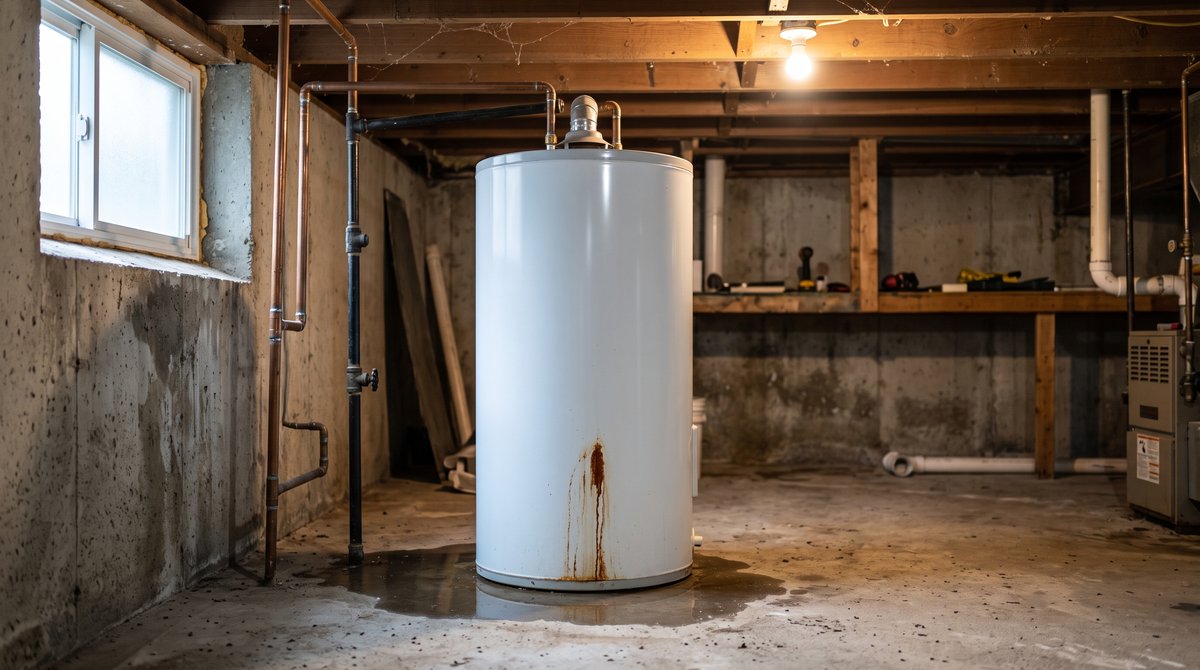
You go downstairs for a load of laundry and the concrete is dark and wet around the base of the tank. There is no obvious burst, no spraying pipe, just water where there should not be any, and it is still coming. A hot water tank leaking in a Calgary basement is one of the most common water damage calls we take, and the outcome depends almost entirely on what you do in the first hour. Shut the right things off, and you are looking at a tank replacement and a day of drying. Leave it running while you look for a plumber’s number, and a 150-litre tank fed by a live supply line will flood the finished half of your basement by dinner.
This guide walks through the seven steps that limit the damage, explains why Calgary’s hard water kills tanks early, shows you how to tell where the leak is coming from, and covers what your insurance is likely to pay for and what it will not.
Table of Contents
- Why hot water tanks fail early in Calgary
- The 7 steps: what to do in the first hour
- Where the water is coming from, and what it means
- How much damage a leaking tank really does
- Does home insurance cover a leaking hot water tank?
- Replacing the tank: permits, and stopping the next leak
- Why DKI Calgary is the right choice for water heater flood cleanup
- Frequently Asked Questions
Key Takeaways
- A hot water tank leaking from the bottom of the tank body is almost always internal corrosion, and the tank needs replacing, not repairing.
- Shut off the cold water supply valve on top of the tank first, then the gas or power; that stops the flow within seconds and is the single most important step.
- Calgary’s hard water shortens tank life: many local plumbers see tanks fail at 8 to 10 years, and sacrificial anode rods are often used up in 3 to 4 years.
- Clean tank water is Category 1 under the IICRC S500 standard, but it degrades to Category 2 within about 48 hours of sitting in carpet and drywall.
- Insurance usually covers the sudden water damage but not the tank itself, and gradual leaks from long-term rust are commonly excluded.
Why hot water tanks fail early in Calgary
Calgary tanks die young because of what comes out of the tap. City water is hard, typically in the range of 150 to 200 milligrams per litre of calcium carbonate and often higher through the winter months when the Bow and Elbow rivers run low. Every time that water is heated, calcium and magnesium drop out of solution and settle at the bottom of the tank as sediment.
Sediment does two things. It insulates the bottom of the tank from the burner, so the steel has to get hotter to heat the same water, and that heat stress accelerates corrosion. It also traps moisture against the tank floor. The sacrificial anode rod that is supposed to protect the steel from rust is designed to last five to seven years; in unsoftened Calgary water it is often gone in three or four. Once the anode is consumed, the tank itself starts to corrode from the inside, and a pinhole at the bottom seam is the usual result.
That is why a tank rated for 12 to 15 years frequently fails at 8 to 10 here. If your tank is past eight years old and you have never flushed it or replaced the anode, treat the first drip as a warning that the tank is finished, not as a repair job.
The 7 steps: what to do in the first hour
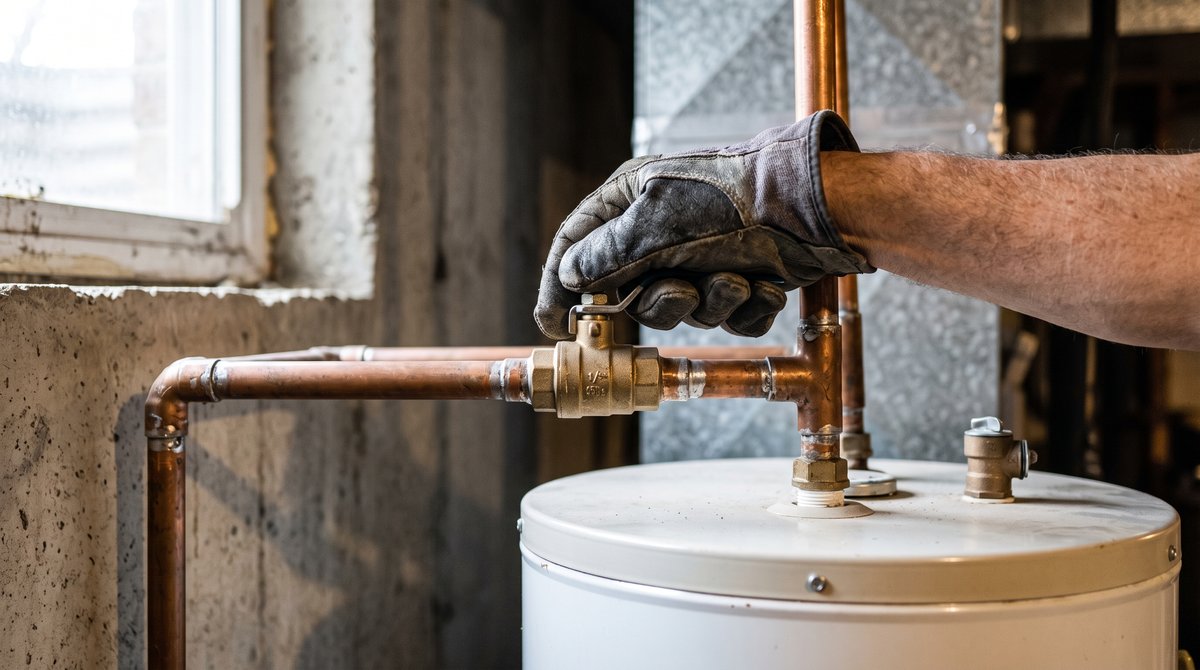
Work through these in order. The first two stop the water; the rest protect your home and your claim.
- Shut off the cold water supply. Look for the valve on the cold inlet pipe at the top of the tank, usually a lever or round handle on the pipe coming from the wall. Turn a lever a quarter turn until it sits across the pipe, or turn a round handle clockwise until it stops. This cuts the supply feeding the leak. If the valve is seized or missing, shut off the main water valve for the house, normally where the water line enters the basement near the meter.
- Shut off the heat source. For a gas tank, turn the control knob on the gas valve to OFF or PILOT, then close the gas shut-off on the supply line if you can reach it. For an electric tank, switch off its breaker at the electrical panel. A tank heating without water in it can crack, and a leaking electric tank is a shock hazard.
- Keep water away from electrical and gas equipment. If water is pooling toward the furnace, electrical panel or outlets, do not walk through it. Shut off the main breaker if you can do so safely from a dry spot; otherwise call an electrician before entering.
- Drain the tank if it is still leaking. Connect a garden hose to the drain valve at the bottom of the tank, run it to a floor drain or outside, open a hot water tap upstairs to let air in, and open the drain valve. Emptying the tank stops it feeding the puddle from what is already inside it.
- Move what you can and soak up what you can. Get boxes, furniture and anything absorbent off the wet floor. Towels and a wet vacuum help on bare concrete, but do not pull up carpet or open walls yourself; that is what the drying equipment is for.
- Photograph everything before it is cleaned up. The tank, the leak point, the extent of the water, the date on the tank’s label and the affected contents. Your insurer will ask, and the adjuster may not arrive for days.
- Call two people: a plumber and a restoration company. The plumber replaces the tank. The restoration company dries the structure. They are different jobs, and the second one is the one homeowners skip. Water that got under flooring or into the bottom of the drywall does not dry on its own before mould starts.
Where the water is coming from, and what it means
Once the water is off, look closely at where it is wet. The location tells you whether you are facing a cheap fitting or a new tank.
| Where it is wet | Likely cause | Repair or replace |
|---|---|---|
| Bottom of the tank body, seeping through the outer jacket | Internal corrosion of the steel tank | Replace the tank |
| Drain valve at the bottom | Loose or worn plastic drain valve | Repair, often a brass replacement valve |
| Pipe fittings on top of the tank | Loose connections or failed dielectric fittings | Repair |
| Temperature and pressure relief valve discharge pipe | Excess pressure, thermal expansion or a failing valve | Repair the valve, but have the pressure checked |
| Puddle with no visible source, tank sweating in summer | Condensation on a cold tank in humid air | Usually no repair needed |
A relief valve that keeps dripping deserves attention. It is doing its job by releasing pressure, and the reason it is releasing pressure is often a closed system with no expansion tank. Ignoring it is how a tank gets stressed into an early failure. A tank sweating in a humid summer basement is harmless, but it is also the one situation people mistake for a leak, so wipe the tank dry and watch where the water reappears.
How much damage a leaking tank really does
A typical residential tank in Calgary holds 150 to 230 litres, roughly 40 to 60 US gallons. That alone is enough to cover a good part of a basement floor. The real problem is that the tank refills as it leaks, so until the supply is shut off the volume is limited only by how long it runs. A slow seam leak discovered after a weekend away can put thousands of litres into a finished basement.
Under the IICRC S500 standard for water damage restoration, water from a supply line or tank starts as Category 1, meaning clean. That changes fast. Once it has soaked into carpet underpad, drywall and the dust and debris on a basement floor for 48 hours or more, it is treated as Category 2, and the drying and cleaning approach changes with it. We explain the categories in more detail in our guide to Category 1, 2 and 3 water damage.
What gets hurt in a typical tank failure:
- Flooring. Laminate swells and is rarely saved. Carpet can often be dried, but wet underpad usually goes.
- The bottom of the walls. Drywall wicks water upward, and the lower 30 to 60 centimetres are often wet well beyond the visible tide line.
- Framing and insulation. Bottom plates and the insulation behind finished walls hold moisture for weeks without forced drying.
- Contents. Cardboard boxes, stored furniture and anything sitting directly on the floor.
Drying a basement properly takes three to five days with air movers and dehumidifiers, and the drying schedule depends on how far the water travelled. Our post on how long water damage takes to dry covers what to expect. If you are deciding what to keep, what to throw out versus save after a basement flood walks through it item by item.
Does home insurance cover a leaking hot water tank?
Usually yes for the water damage, and usually no for the tank. Standard home policies in Alberta cover sudden and accidental water damage from a plumbing system or appliance, which includes a hot water tank that fails without warning. The flooring, drywall, drying and contents are typically claimable, subject to your deductible. The tank itself is a mechanical failure and is generally not covered, so the replacement comes out of your pocket.
Two situations cause denials. The first is gradual damage: if the adjuster finds long-standing rust staining, a corroded pan or evidence the tank had been weeping for months, the insurer can argue the loss was not sudden. The second is neglect, where a tank far past its service life shows signs of obvious deterioration that was never addressed. The Insurance Bureau of Canada’s overview of how home insurance works is a good primer on what standard policies include, and our post on whether water damage is covered by home insurance in Calgary goes into the local details.
Three things protect your claim: shut the water off quickly so the damage is clearly limited, photograph the tank and the leak before anything is moved, and get professional drying documented with moisture readings. Adjusters approve claims that are well documented and mitigated promptly, and they push back on ones that were left to sit.
Replacing the tank: permits, and stopping the next leak
In Calgary, a gas-fired water heater replacement requires a gas permit, and homeowners cannot pull one themselves unless they hold a gasfitter certificate. The permit has to be taken out by a licensed contractor, and a plumbing permit is needed as well if the plumbing connections change. The City’s plumbing and gas permits page sets out the requirements. An inspected, permitted installation also matters for your insurance the next time something goes wrong.
Once the new tank is in, a few habits stop the cycle from repeating:
- Flush the tank every six to twelve months to clear sediment before it hardens. In Calgary, once a year is the minimum.
- Check the anode rod at year three and replace it when it is mostly consumed. This is the cheapest life extension a tank can get.
- Install a drain pan with a line to a floor drain if the tank sits in or near finished space.
- Add a leak sensor or an automatic shut-off valve. A sensor on the floor beside the tank costs less than a deductible, and an automatic valve closes the supply the moment it detects water.
- Write the install date on the tank and plan on replacement around year ten, before it chooses the date for you.
Why DKI Calgary is the right choice for water heater flood cleanup
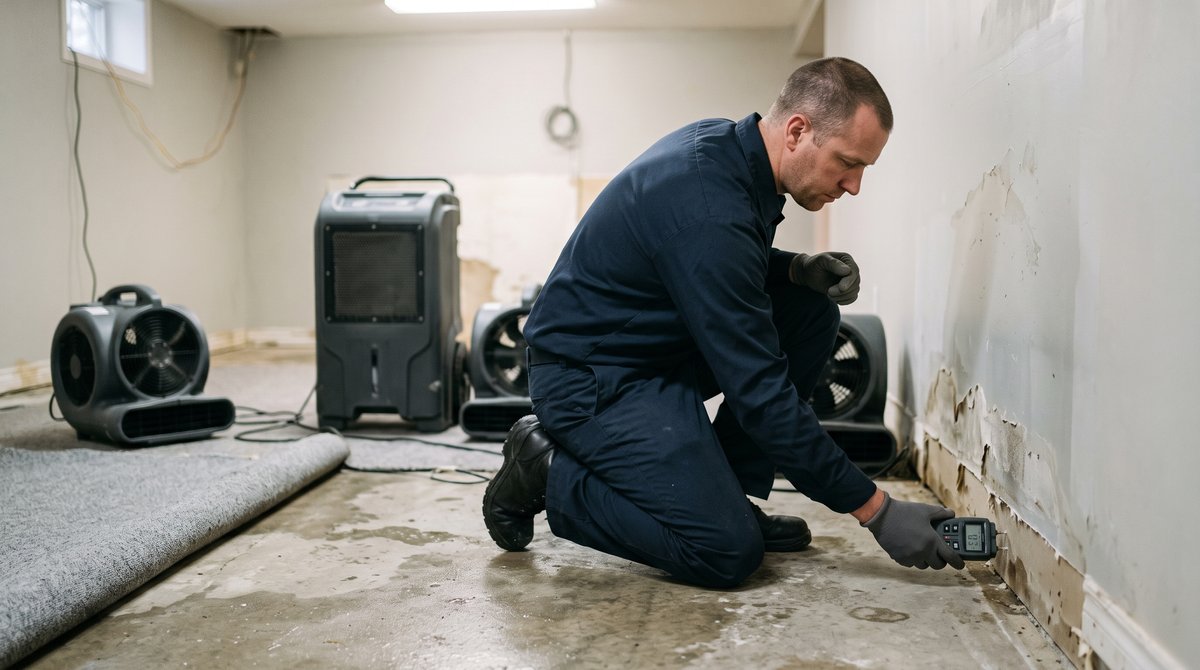
A failed hot water tank is a small emergency that becomes a large one when the drying is skipped. DKI Calgary’s water and flood damage restoration team handles tank failures every week across Calgary, Airdrie, Cochrane, Chestermere and the surrounding communities, and the work is the same each time: extract the standing water, measure how far it travelled with moisture meters, set up drying equipment sized to the space, and document every reading for your insurer.
Our technicians are IICRC certified and follow the S500 standard, we respond 24 hours a day, and we work directly with adjusters so the claim moves while the basement dries. For homeowners, our residential restoration services cover everything from the first extraction to rebuilding the finished walls.
Conclusion
A hot water tank leaking in a Calgary basement is rarely a surprise in hindsight. Hard water, sediment and a spent anode rod wear the tank out years ahead of its rated life, and the first drip at the bottom seam means the end is close. What you control is the damage. Shut off the cold supply and the heat source, drain the tank, keep water away from electrical equipment, photograph the scene and get the structure dried by people who measure moisture rather than guess at it. Insurance will usually cover the water damage if you act quickly and document well, and a permitted replacement with a drain pan and a leak sensor means the next tank fails quietly instead of expensively.
Frequently Asked Questions
Why is my hot water tank leaking from the bottom?
Water seeping through the outer jacket at the bottom of the tank almost always means the inner steel tank has corroded through. Sediment from Calgary’s hard water and a used-up anode rod are the usual causes. It cannot be repaired; the tank needs replacing, and the sooner the supply is shut off the less water reaches your floor.
Is a leaking hot water tank an emergency?
Yes, because the tank keeps refilling as it leaks. Shut off the cold water valve on top of the tank and the gas or power right away, then drain it. Once the water has stopped, the emergency is over and the priority becomes drying the floor and walls within the first 48 hours to prevent mould.
How long do hot water tanks last in Calgary?
Most tanks are rated for 12 to 15 years, but in unsoftened Calgary water many fail at 8 to 10. Annual flushing, replacing the anode rod every three to four years, and a water softener can add several years. Plan on replacement around year ten rather than waiting for a leak.
Will insurance pay for a new hot water tank?
Generally no. The tank is treated as a mechanical failure and is not covered. The sudden water damage it causes, including flooring, drywall, drying and contents, is usually covered under a standard Alberta home policy, as long as the leak was not gradual or the result of obvious neglect.
Can I replace a hot water tank myself in Calgary?
Not a gas one. The City of Calgary requires a gas permit for gas water heaters, and only a licensed contractor with a gasfitter certificate can take one out. An electric tank still needs its wiring handled safely, and any plumbing changes require a plumbing permit. Use a licensed installer and keep the permit paperwork.
Do I need a restoration company if the water only covered the floor?
If the floor is bare concrete and the water was caught within an hour, a wet vacuum and fans may be enough. If the water reached carpet, laminate, drywall or a finished wall, the moisture is now inside materials that do not dry on their own, and professional drying with moisture readings is the only way to be sure mould does not start.