
Key Takeaways
- Act within 24–48 hours — mold colonies form on wet porous materials inside that window, per IICRC S500 water-damage standards.
- Identify the water category first: clean supply line (Cat 1), grey water (Cat 2), or sewage / river backup (Cat 3) — Cat 3 forces broader disposal.
- Throw out porous items soaked by Cat 2 or Cat 3 water: drywall, insulation, carpet pad, mattresses, upholstered furniture, MDF or particleboard.
- Save hard non-porous items — glass, sealed metal, dense hardwood, ceramics — after washing with detergent and a sanitizer solution.
- Photograph everything before moving it; Calgary insurers and the City of Calgary Sewer Backup Subsidy Program require itemized proof of loss.
- If sewage, Bow or Elbow River water, or fuel is involved, do not enter the basement until a professional restoration team has assessed it.
Table of Contents
Why the Decision Matters in Calgary
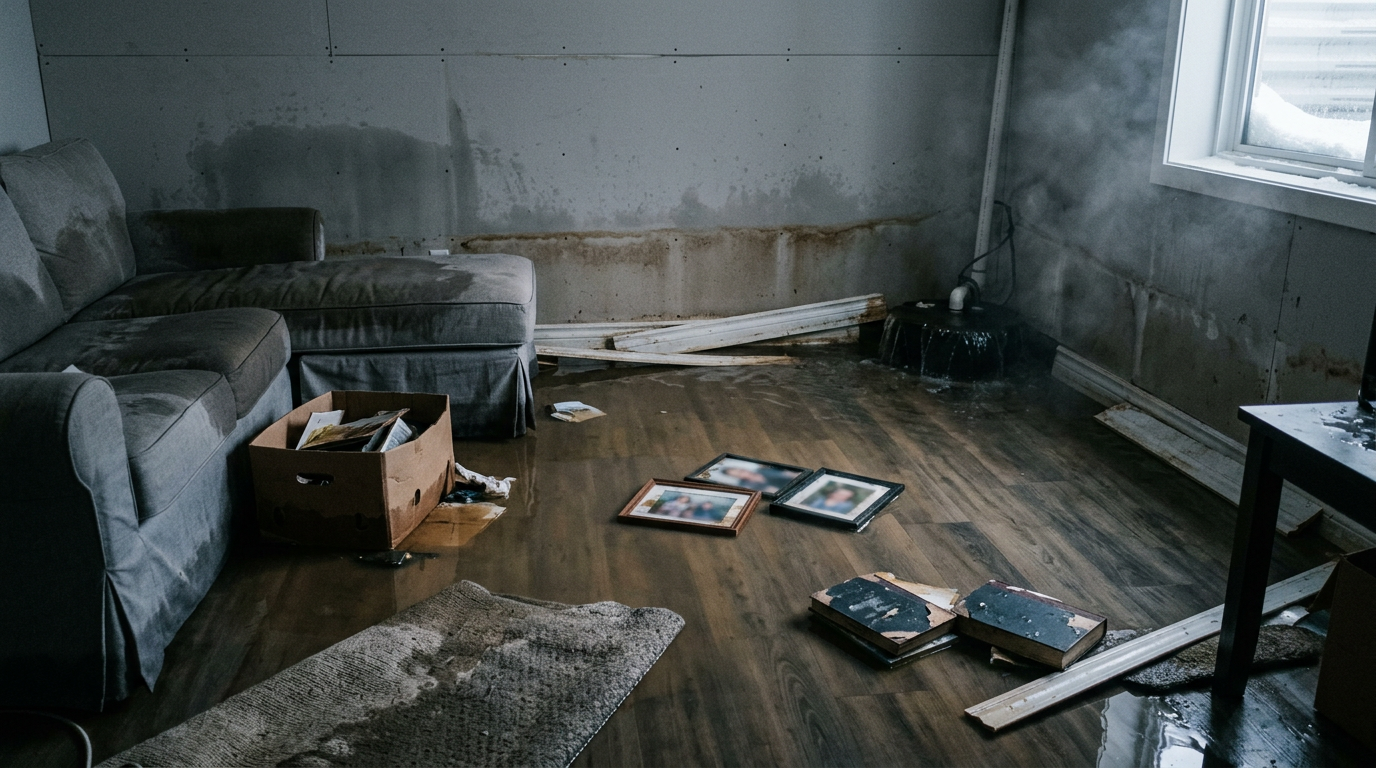
Calgary basements take a unique beating. Between the June 2013 Bow and Elbow River flood, recurring spring snowmelt across Bridgeland, Sunnyside, Roxboro and Elbow Park, and the city’s chinook-driven freeze-thaw cycle, most local restoration jobs we see start the same way: a homeowner standing in 2–10 cm of water, wondering what is salvageable and what is now landfill.
The decisions you make in the first 48 hours determine three things: your final repair cost, whether mold takes hold in your wall cavities, and how much your insurer will reimburse. Get this wrong and a $15,000 cleanup can balloon to a full water and flood damage restoration project plus mold remediation.
This guide gives you the same framework our technicians use on-site every week. It is built on the IICRC S500 Standard for Professional Water Damage Restoration, City of Calgary guidance, and Health Canada mold recommendations.
Step 1 — Classify the Water Before You Touch Anything
IICRC defines three categories. The category is the single biggest factor in what you keep.
- Category 1 — Clean water
- Burst supply line, an overflowed bathtub before soap or use, a leaking water heater intake. Safe to handle with basic PPE. Most porous items can be dried and saved if treated within 24–48 hours.
- Category 2 — Grey water
- Washing-machine discharge, dishwasher leaks, aquarium spills, sump-pump overflow. Contains significant biological or chemical contamination. Many porous items must be discarded.
- Category 3 — Black water
- Sewer backups, toilet overflows with solids, river floodwater, anything left standing more than 48 hours. Treat all porous and semi-porous items that contacted this water as unsalvageable.
Calgary homeowners hit hardest by Category 3 events are usually those on combined storm-sanitary lines or in low-lying communities along the Bow and Elbow. If your flood came from a backed-up floor drain or toilet, read our detailed sewer backup response guide before you start sorting.
Step 2 — The Save vs. Throw Out Comparison Table
Use this table as your on-the-floor reference. It assumes Category 2 water (the most common Calgary scenario — sump failure, appliance leak, or seepage from saturated soil).
| Item | Save | Throw Out | Why |
|---|---|---|---|
| Drywall (lower 30–60 cm) | — | ✔ | Wicks water vertically; gypsum core supports mold within 48 h. |
| Fibreglass / batt insulation | — | ✔ | Holds water indefinitely, loses R-value, becomes a mold reservoir. |
| Hardwood flooring | Maybe — if dried in place within 72 h | If cupped/buckled or under standing water 24 h+ | Solid hardwood can be sanded; engineered wood and laminate cannot. |
| Vinyl plank / LVT | ✔ (clean and disinfect) | If subfloor underneath is soaked | Non-porous surface, but moisture trapped beneath causes mold. |
| Mattresses & box springs | — | ✔ | Impossible to fully dry or sanitize internally. |
| Upholstered furniture (couches, recliners) | Rare — only high-value pieces, professionally restored | Typically ✔ | Foam and stuffing absorb contamination and cannot be heat-sanitized. |
| Solid wood furniture | ✔ if dried and re-finished | If particleboard / MDF construction | Particleboard swells and disintegrates; solid wood survives. |
| Books, photos, paper documents | ✔ with freeze-drying for high-value items | If sewage-contaminated | Cat 3 items cannot be sanitized for handling. |
| Electronics | Sometimes — if sealed and not powered on | If powered on while wet | Residual corrosion continues internally even after drying. |
| Clothing, linens | ✔ — hot wash + sanitizer cycle | If sewage-soaked, especially items hard to launder | Most textiles tolerate sanitizing wash. |
| Sealed canned food | ✔ after disinfecting the can | Any food in cardboard, paper, or with crimped seals | Cardboard wicks contamination through to product. |
| Cosmetics, medication, baby items | — | ✔ | Health Canada and AHS guidance: discard if contacted by floodwater. |
| Cardboard boxes & contents | Contents may be saveable; box must go | The box itself: ✔ | Cardboard is the fastest mold substrate in your basement. |
Step 3 — The 48-Hour Save Window
Mold spores are everywhere in Calgary homes year-round. They only become a problem when they find moisture and a porous food source. The Health Canada mold guidance and EPA both reference the same 24–48 hour mold colonization window.
That window is your true deadline. Below is the order our restoration teams work in when the homeowner has called us inside 24 hours.
- Document the loss. Photograph and video every room and every item from multiple angles before moving anything. Calgary insurers, and the City of Calgary’s Sewer Backup Subsidy Program, require itemized evidence.
- Extract standing water. Submersible pumps and truck-mounted extractors first. Do not begin sorting until water is below ~1 cm.
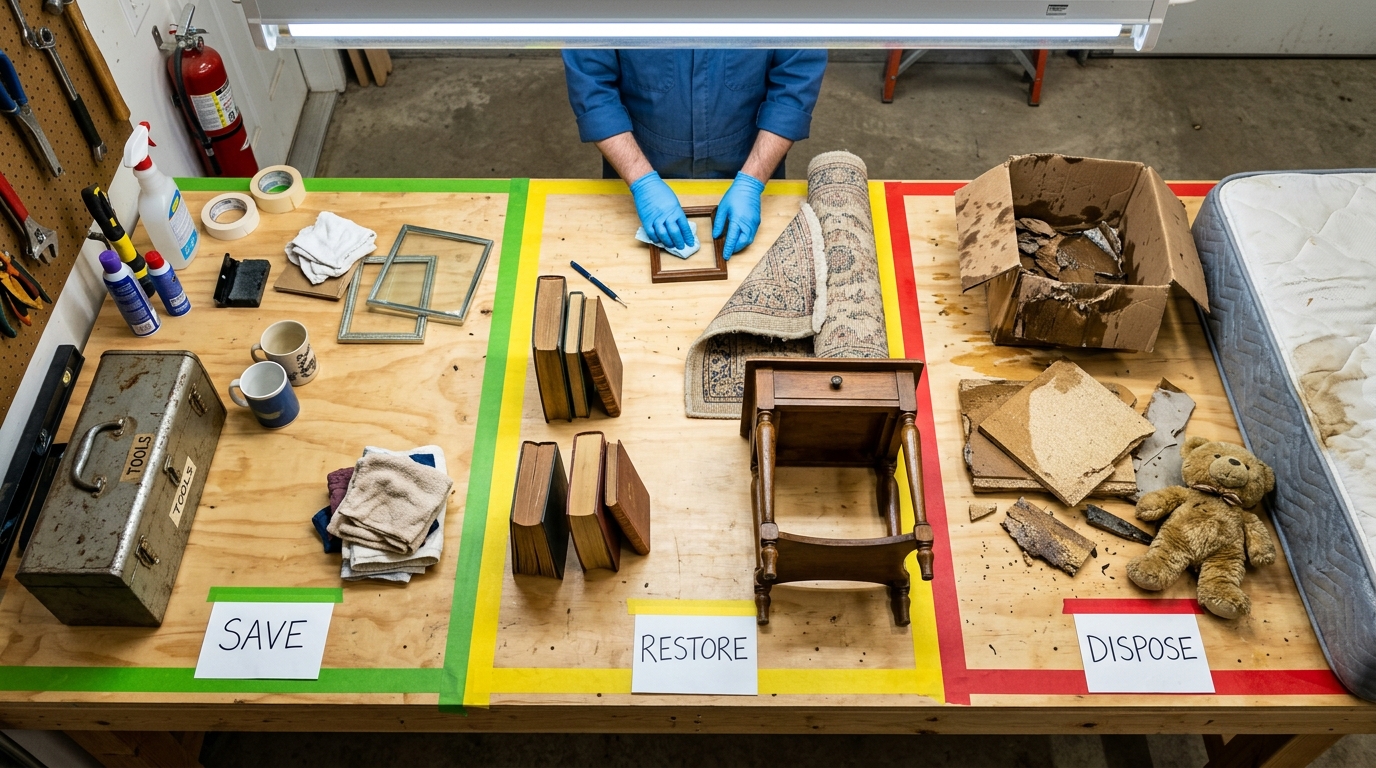
- Move contents to a clean, dry triage area. Often the garage or main floor. Group by Save / Restore / Dispose.
- Remove unsalvageable building materials. Cut drywall 60 cm above the tide line, pull soaked insulation, lift carpet and underpad.
- Dry the structure. Commercial-grade dehumidifiers and air movers, targeting <15% moisture content in wood and <1% in concrete before reconstruction.
- Sanitize. Antimicrobial application appropriate to the water category. Cat 3 sites get an additional fogging pass.
If you are seeing the signs after the fact — soft baseboards, musty smell, paint blistering — review our signs of hidden water damage guide before assuming you’ve dodged the worst.
Step 4 — Cleaning Items You Decide to Save
Saving an item does not mean wiping it off and putting it back. Salvage requires a documented clean-and-disinfect process, especially for anything that touched Cat 2 water.
- Hard non-porous items (glass, metal, ceramics, sealed plastic)
- Wash with hot water and detergent, rinse, then disinfect with a registered antimicrobial or a 1:10 household bleach solution (10 minutes contact time). Air-dry fully before storing.
- Solid wood furniture
- Wipe with a damp cloth and mild detergent, never soak. Move to a dry, ventilated room. Expect 5–10 days of slow drying. Refinish only after wood reaches <15% moisture content.
- Clothing & soft textiles
- Hot-water wash with detergent plus a colour-safe sanitizer (e.g., Lysol Laundry Sanitizer). Two cycles for heavily soiled items. Dry on the highest fabric-safe heat setting.
- Photos, documents, books (high sentimental or legal value)
- Freeze immediately in a sealed plastic bag to stop ink bleed and mold, then send to a professional document-recovery vendor. Our contents restoration team handles this routinely for Calgary clients.
Step 5 — What Calgary Homeowners Throw Out Too Soon
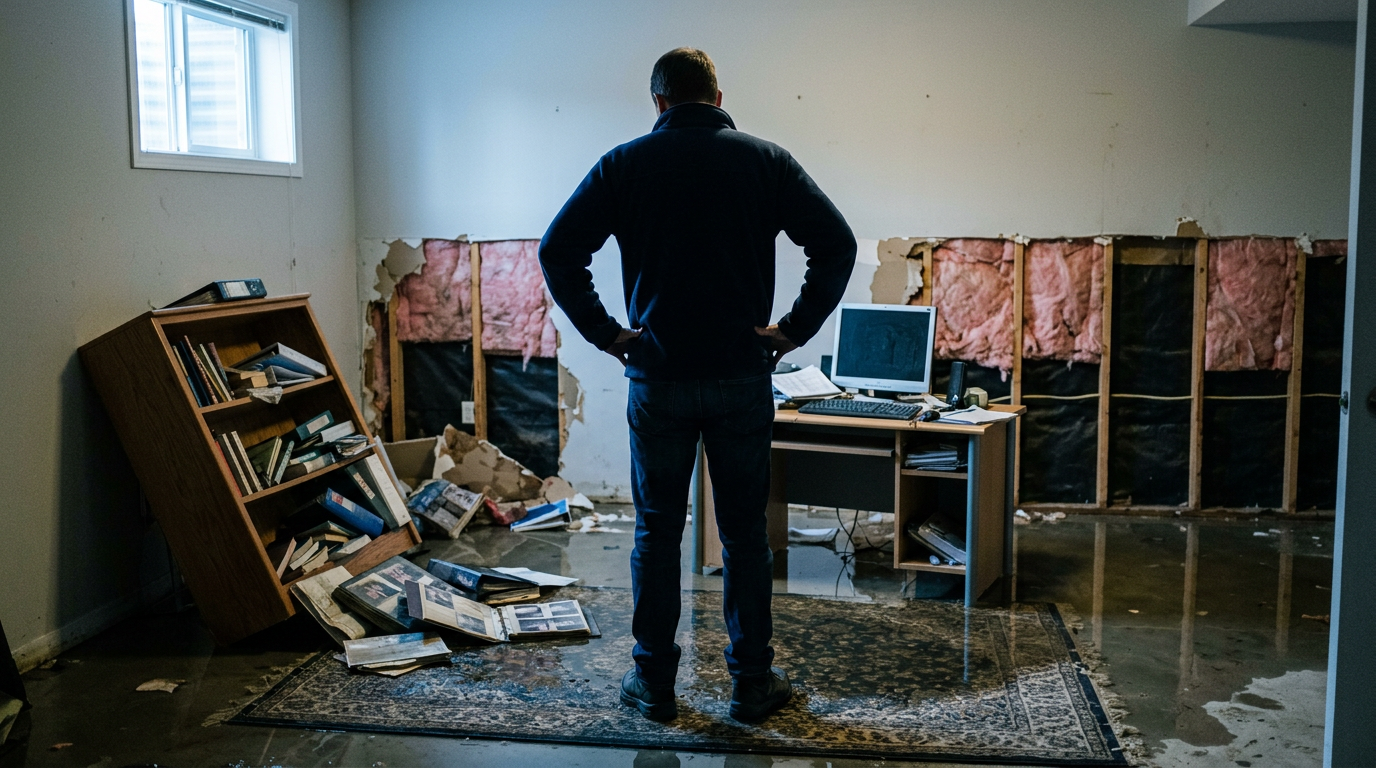
Most Calgary homeowners over-discard rather than under-discard. Insurance adjusters routinely flag items that could have been restored. Before tossing, double-check these categories:
- Solid wood antiques and heirlooms — often restorable through controlled drying.
- Leather goods and shoes — saveable if cleaned within 48 hours and reconditioned.
- Art on canvas or paper — freeze and consult a conservator before discarding.
- Wedding dresses, christening gowns, quilts — specialty textile cleaners can save most of these.
- Vinyl records, hard drives, board game tokens — non-porous components survive surprisingly well.
A reputable restoration company will pack out borderline items, dry them in a controlled chamber, and only then make the final salvage call. That extra step often pays for itself in claim value.
Step 6 — Calgary-Specific Considerations
A few local realities change the math:
Spring thaw and frozen ground. Calgary’s clay soils stay frozen long after surface snow melts, sending water sideways into foundation cracks rather than down. Items stored on basement floors during March and April are at higher risk than in summer. Our spring thaw flooding guide covers prevention in depth.
Combined sewer-storm systems in older areas. Inglewood, Ramsay, parts of Hillhurst and Killarney can see backups during heavy summer storms. Any water from a floor drain in these neighbourhoods is Cat 3 by default — assume the worst.
Alberta Building Code R-values. When you replace basement insulation post-flood, current code (Section 9.36) often requires more insulation than your original 1990s or 2000s build. Budget for the upgrade.
The Sewer Backup Subsidy Program. Calgary offers a subsidy of up to $3,000 for sump pumps and backwater valves. Keep documentation from this loss to support your application — it materially reduces your next flood’s severity.
For a broader playbook on prevention and recovery, see our complete basement flooding guide for Calgary homeowners.
FAQs — What Calgary Homeowners Ask Us Most
Can I save a wet mattress if I dry it in the sun?
No. Even with several days of Calgary summer sun, the interior of a mattress retains moisture and cannot be sanitized to a safe sleeping standard. Mattresses that contacted any Category 2 or 3 water should be discarded. The same applies to box springs and most pillows.
Do I have to remove drywall if it only got damp at the bottom?
Yes, in most cases. Drywall wicks water vertically — a tide line at 10 cm typically means moisture has migrated 30–60 cm up the panel. Standard practice (and Alberta Building Code expectations for post-flood repair) is to cut drywall to at least 60 cm above the visible water line and replace soaked insulation behind it.
Is bleach enough to disinfect after a sewer backup?
For hard, non-porous surfaces, a properly diluted 1:10 bleach solution with 10 minutes of contact time is effective. Porous materials cannot be disinfected with bleach at all — they must be discarded. After a sewer backup, additional antimicrobial fogging is recommended for the structural shell before reconstruction.
Will my insurance cover items I throw out before they’re assessed?
Usually yes, provided you photographed and inventoried everything first. Insurers do not expect you to live with biohazards while waiting for an adjuster. Document thoroughly, keep a sample of high-value damaged materials (e.g., a piece of soaked carpet), and write down model and serial numbers from any electronics.
How long until mold becomes a problem after a Calgary basement floods?
Visible mold growth typically begins on porous wet materials between 24 and 72 hours after the flood, regardless of season. Calgary’s dry climate slows surface mold slightly but does not stop colonization inside wall cavities or under flooring, where humidity stays high.
Should I run my furnace or HVAC after a basement flood?
Not until a technician has inspected the system. Forced-air systems can draw airborne mold spores and contaminants throughout the house. Most Calgary restoration teams seal supply and return registers in the affected area as one of the first steps.
Every hour after a basement flood widens the gap between “restorable” and “landfill” — and the cost difference can be tens of thousands of dollars.
Request a 24/7 emergency basement flood assessment from DKI Calgary →