
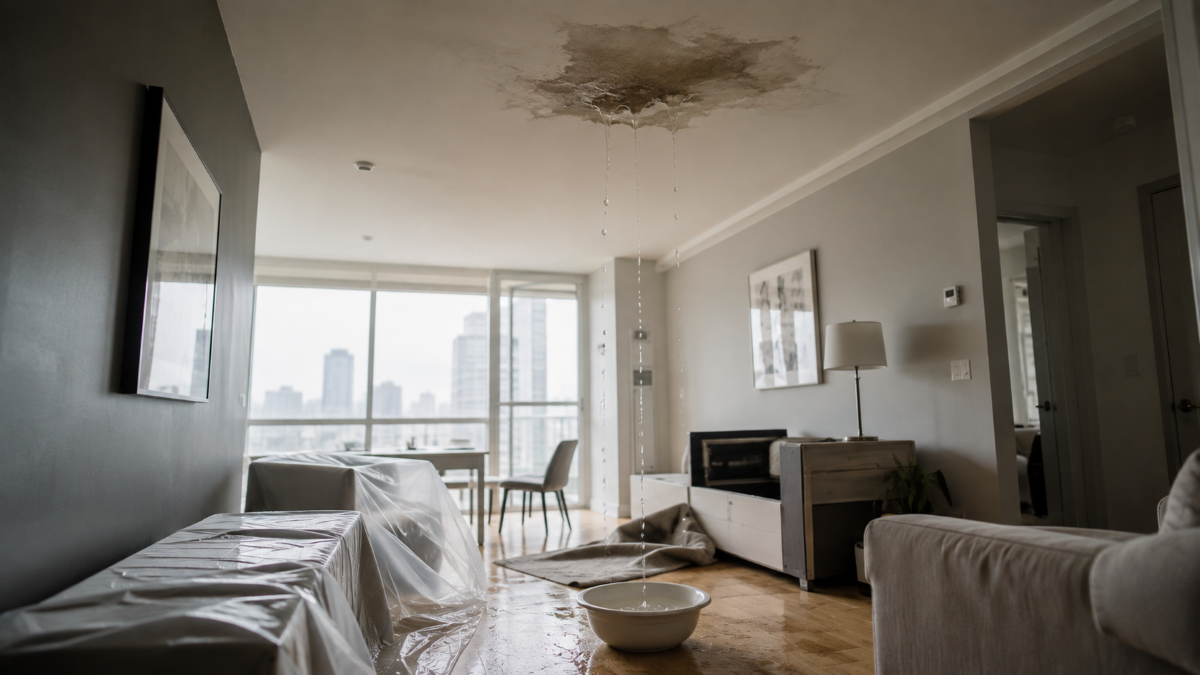
A supply line lets go under your kitchen sink while you are at work. By the time you get home the water has crossed your floor, soaked into the subfloor, and come through the ceiling of the unit below. Then the property manager tells you the building’s insurance deductible is $50,000 — and it is yours to pay. Sorting out condo water damage in Calgary is not like a detached home, because two insurance policies and a piece of Alberta legislation decide who pays for what. This guide explains the rules, the $50,000 chargeback, the three situations where you are not liable, and what to do in the first hour.
Table of Contents
Key Takeaways
- Since January 1, 2020, an Alberta condo corporation can charge its insurance deductible back to a unit owner, up to a maximum of $50,000.
- You can be liable for that deductible even if you did nothing wrong — negligence does not have to be proven for amounts up to $50,000.
- What matters is where the water started, not who caused it. Damage originating in your unit is your exposure.
- There are three exceptions: construction defects, acts or omissions of the corporation, and normal structural deterioration.
- Corporate deductibles on Calgary buildings commonly run $25,000 to $100,000 or more, which is why deductible coverage on your own policy matters.
Who pays for water damage in a Calgary condo?
In most cases, the condo corporation’s insurance pays to repair the building — and then charges its deductible back to the owner of the unit where the water started. Your own condo policy is what covers that deductible, your belongings, and any improvements you have made to the unit. The split is not decided by fault. It is decided by where the water originated and by what the corporation’s policy treats as part of the building.
This surprises people, because it is the opposite of how car insurance works. In a condo, a burst hose in your unit that damages three floors below you is a building claim, and you can be handed the deductible for it whether or not anyone could reasonably have prevented the failure.
The practical consequence: the cost of a condo water loss is rarely the repair bill. It is the deductible. Getting the water out fast still matters enormously — our water and flood damage restoration team responds around the clock precisely because every hour of standing water widens the claim.
The two insurance policies in every condo
Every condominium has at least two policies running at once, and understanding the boundary between them is most of the battle.
The corporation’s policy covers the common property and the building structure — the roof, hallways, elevators, exterior, and the units as originally built to a defined standard. It does not cover your personal belongings, your upgrades, or your personal liability.
Your unit owner’s policy covers what the corporation’s policy does not: contents, improvements and betterments, personal liability, additional living expenses if you are displaced, and — critically — the corporation’s deductible if it is charged back to you.
| What is damaged | Usually covered by |
|---|---|
| Building structure and common property | Corporation’s policy |
| The unit as originally built (per the SIUD) | Corporation’s policy |
| Your upgrades and improvements | Your policy |
| Your furniture, clothing and belongings | Your policy |
| The corporation’s deductible charged to you | Your policy, if you carry that coverage |
| Hotel and living costs while displaced | Your policy |
A great many Calgary condo owners carry a policy that handles contents and liability but carries little or no deductible coverage. That gap is where a routine leak turns into a five-figure personal loss. Our guide on what property damage insurance actually covers walks through the wider coverage picture.
Alberta’s $50,000 deductible chargeback rule
This is the rule that catches owners off guard. Under the Condominium Property Regulation, changes that took effect on January 1, 2020 allow a condominium corporation to recover its insurance deductible from an owner when the damage and the resulting claim originated in that owner’s unit or exclusive possession area — up to a maximum of $50,000.
The critical wording is that for amounts up to $50,000, the corporation does not have to prove negligence. Government of Alberta guidance puts it plainly: for deductible costs up to that ceiling, corporations do not need to show the owner did anything wrong. Liability follows the origin of the water.
Two things make this expensive in practice. First, corporate deductibles have climbed steeply — figures of $25,000 to $100,000 or more are now common on Alberta buildings, so the full $50,000 is often in play. Second, the claims that trigger it are ordinary: a failed supply line, an overflowing tub, a dishwasher hose, a toilet, an in-suite hot water tank.
The $50,000 cap is a ceiling on the no-fault route, not a cap on your total exposure. Where a corporation can prove negligence or intentional damage, the regulation preserves its right to sue for the balance in a civil action. Ignoring a slow leak for months is exactly the fact pattern that turns a capped chargeback into an uncapped lawsuit.
When you are not on the hook

The regulation lists specific situations where a corporation cannot charge the deductible to an owner. You are not liable when the damage was caused by:
- An act or omission of the corporation, or of someone employed by the corporation — a contractor who cut a line, or maintenance that was never performed.
- A construction defect — a builder’s error in the plumbing or building envelope rather than anything you did or own.
- Normal structural deterioration of the building — aged common-property pipes reaching the end of their life.
There is a fourth, simpler protection: damage that originated outside your unit is not chargeable to you. If the water came from the hallway, the roof, a riser in the common property, or a neighbour’s suite, the origin is not yours and neither is the deductible.
This is exactly why the cause of loss has to be established properly, and quickly. A leak inside a wall shared between two units can plausibly be assigned to either, and the answer is worth $50,000. Professional documentation at the outset — moisture mapping, photographs, thermal imaging before demolition — is often what settles it. Our guide on signs of hidden water damage in walls and floors covers how these losses are traced.
The Standard Insurable Unit Description
The Standard Insurable Unit Description, or SIUD, is the document that defines what counts as “standard” inside a unit — the flooring, fixtures, cabinetry, appliances and wall finishes the corporation’s policy will restore after a loss. Anything you have installed beyond that standard is an improvement, and improvements are yours to insure.
Say the SIUD describes builder-grade laminate and your unit has engineered hardwood. After a flood, the corporation’s policy restores to laminate. The difference in cost comes out of your policy, if you carry improvements coverage in a high enough amount, or out of your pocket if you do not.
Two practical steps follow. Ask your corporation for the current SIUD and read it. And when the SIUD changes, the corporation must notify owners and provide insurance certificates within 30 days — that notice is your cue to check your own coverage limits still line up. Owners who renovated years ago are frequently underinsured by exactly the value of the renovation.
What your own condo policy needs to cover
A condo owner’s policy in Calgary should be built around the gaps described above rather than bought on price alone. The pieces that matter most:
- Deductible assessment or loss assessment coverage, in an amount at least matching the corporation’s deductible. If the building carries a $50,000 water deductible, coverage below that leaves the difference with you.
- Improvements and betterments, sized to what you have actually upgraded since the SIUD was written.
- Contents, at replacement cost rather than actual cash value.
- Personal liability, for damage your unit causes to others.
- Additional living expenses, because condo water losses routinely make a suite uninhabitable for weeks during drying and rebuild.
- Sewer backup, which is a separate endorsement in most policies.
Ask your broker two direct questions: what is my building’s water deductible today, and does my policy cover that full amount? Corporate deductibles are raised at renewal and owners are rarely told in a way that prompts action. Our post on whether water damage is covered by home insurance in Calgary covers the coverage distinctions in more depth, and sewer backup in Calgary explains that endorsement.
What to do in the first hours of a leak
What you do in the first hour shapes both the size of the loss and the strength of your position on the deductible.
- Shut off the water. Know where your in-suite shutoff is before you need it. If you cannot stop it, call the building’s emergency line to isolate the riser.
- Stay safe. Keep away from electrical panels and outlets near standing water, and treat water that has travelled through other units or sewage as contaminated.
- Photograph everything before anything is moved or torn out. Wide shots, close-ups, and video of the source itself. This is the evidence that establishes origin.
- Notify both the property manager or board and your own insurer. Do not wait to see how bad it is.
- Call a restoration company immediately. Mould can begin within 24 to 48 hours, and category of water worsens with time — our explainer on IICRC water damage categories covers why that matters.
- Do not start demolition yourself. Tearing out drywall before the loss is documented can destroy the evidence of where the water came from.
Speed genuinely reduces the bill. Drying a wet suite in days rather than weeks limits how far the claim spreads into neighbouring units, and a smaller claim is a smaller argument. Our guide on how long water damage takes to dry sets realistic expectations for the process.
Why DKI Calgary is the right choice for condo water damage
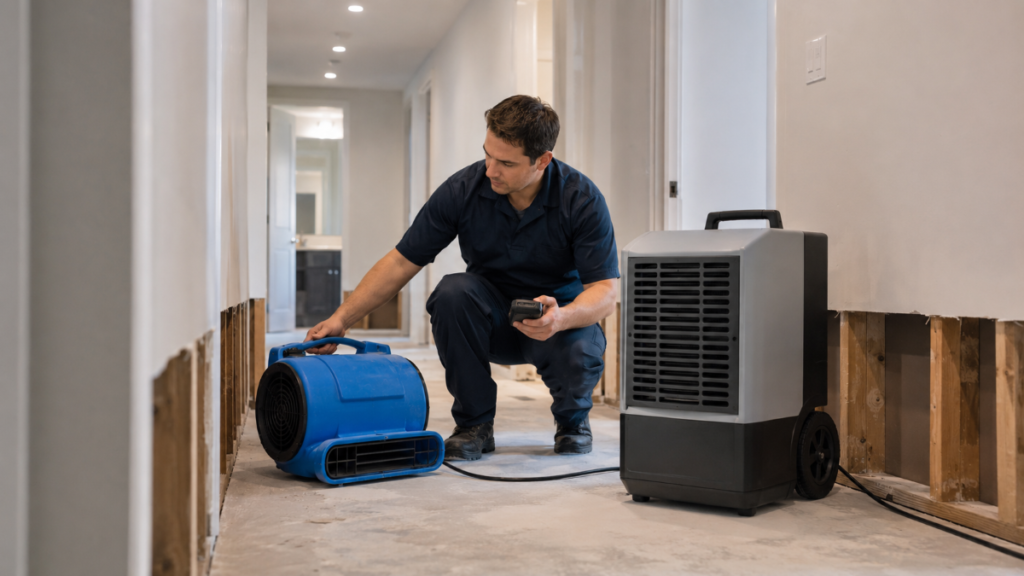
DKI Calgary is part of North America’s largest disaster restoration network, and condo and multi-unit losses are among the most common calls we take. These jobs are different from a detached home: water crosses ownership boundaries, two insurers are involved, and a property manager, a board and several owners all need answers at once.
We work these losses so the documentation holds up on both sides of the deductible question — moisture mapping, thermal imaging, and photographic records of the source before anything is opened up. We coordinate with property managers and adjusters directly, and because we handle extraction, structural drying, contents restoration and rebuild in-house, your suite is one continuous recovery rather than four separate trades.
For buildings and management companies, our property management services put a response plan in place before the loss happens. Local, certified, and available any hour — we are who Calgary buildings call when water is moving.
Conclusion
Condo water damage in Calgary follows a different logic than any other property loss. The corporation’s policy repairs the building, your policy covers your side of the line, and Alberta’s rules let the corporation charge its deductible back to whoever’s unit the water came from — up to $50,000, with no need to prove you did anything wrong. Read your SIUD, confirm your deductible coverage matches the building’s actual deductible, and know where your shutoff is. Then, if water does start moving, document the source before anything is torn out and get professionals drying it the same day. That sequence is what keeps a bad afternoon from becoming a very expensive year.
Frequently Asked Questions
Who pays for water damage in a Calgary condo?
The condo corporation’s insurance generally pays to repair the building, then charges its deductible back to the owner of the unit where the water originated. Your own condo policy covers that deductible, your contents and your improvements — provided you carry enough deductible coverage.
Can my condo corporation charge me the deductible if the leak was not my fault?
Yes. Since January 1, 2020, Alberta corporations can recover their deductible from an owner up to $50,000 without proving negligence, as long as the damage originated in that owner’s unit or exclusive possession area. Fault only becomes relevant above that amount.
What is the maximum deductible I can be charged in Alberta?
$50,000 under the no-fault chargeback rule. Above that, the corporation must pursue a civil claim and prove negligence or intentional damage, so the cap limits the automatic exposure rather than your total possible liability.
When can I not be charged the corporation’s deductible?
When the damage was caused by an act or omission of the corporation or its employees, by a construction defect, or by normal structural deterioration. You also cannot be charged for damage that originated outside your unit, such as from a hallway, the roof or a neighbour’s suite.
What is a Standard Insurable Unit Description?
The SIUD defines what counts as standard within a unit — the flooring, fixtures and finishes the corporation’s policy will restore after a loss. Anything above that standard is an improvement you must insure yourself, which is why owners who have renovated are often underinsured.
Does my condo insurance cover me if I have to move out during repairs?
A unit owner’s policy typically includes additional living expenses, which covers reasonable accommodation and extra costs while your suite is uninhabitable. Condo water losses often require weeks of drying and rebuild, so confirm the limit is realistic for Calgary rents.